Nine steps everyone can name
Including the children. Say them out loud twice and the whole house is using the same list.
A handbook for parents
One calm, practical method for deciding what to do when something goes wrong: at home, on the road, in a storm, in a crowd. Nine steps, ranked by what being wrong costs you.

The problem
Not because they are careless. There is never an obvious evening to have it, so the first real decision gets made under pressure, out loud, in front of the kids.
None of that is a gear problem. Every one is a decision that was available in advance and got left until it was expensive.
The idea
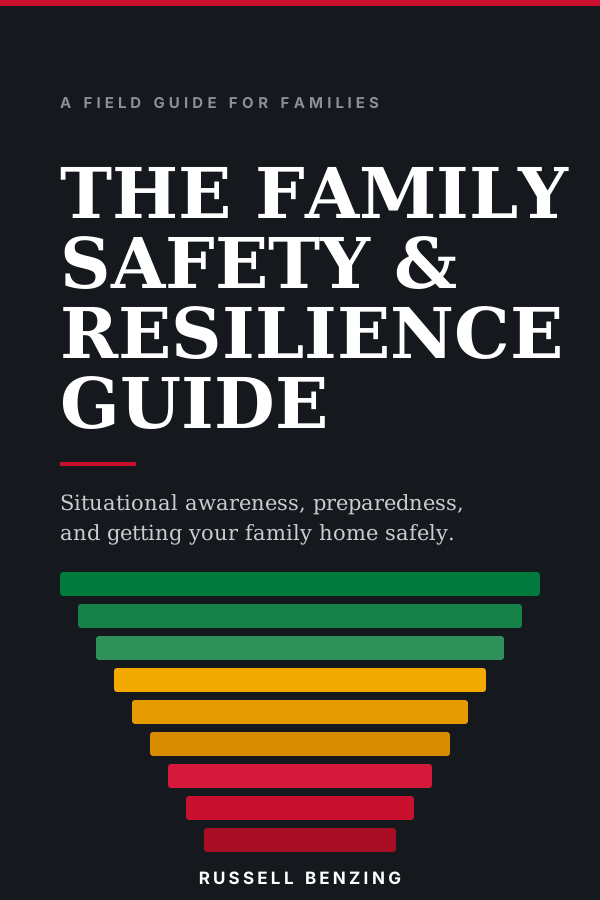
Most safety guides hand you a list of disasters. This one gives you a way of deciding, then applies it 43 times. Two ideas to learn, and both fit on a fridge magnet.
How you process a situation.
Run it fast, then run it again. A decision that was right ninety seconds ago can be wrong now, and families get into trouble by committing to one past the point where it still fits.
What you choose from, ranked by what being wrong costs you.
Leaving a restaurant when nothing was wrong costs you a dinner. Using force when something else would have worked costs you the rest of your life. The further down, the fewer options you have left.
You do not need certainty to move up the Funnel. You only need certainty to move down it.
Chapter 2, The Family Safety Funnel
What you get
Every chapter ends with a DECIDE NOW box: the decisions that get much harder once something is happening. Ten minutes an evening.
Including the children. Say them out loud twice and the whole house is using the same list.
The Family Decision Matrix turns nine common situations into answers you agreed on calmly. Four seconds instead of forty minutes.
One page, instructions only. The chapters are for the couch. The cards are for two in the morning with the lights out.
A 15-minute bag, a 72-hour kit and a two-week plan, each built around how long you have, not a shopping list.
Words a parent actually says, matched to what a child of that age can hold on to.
Self-defense, firearm transport, duty to retreat. The guide never tells you the law. It shows you how to look it up at the source.
How it works
Checkout is handled by Stripe. Your card details never touch this site.
The PDF and the EPUB, together. No DRM, no app, on every device you own.
Read Chapter 2, then do its DECIDE NOW box out loud. Ten minutes.
Peek inside
Real pages from the guide, exactly as they print. 43 chapters in 15 parts, plus three appendices.


Hypothetical. You are walking back to your car in a parking garage, third level, with your partner and your eight-year-old. A man is standing between you and your car. He is not doing anything. He is just standing there, and he has been standing there since you came out of the stairwell, and he is watching you walk.
Your partner has not noticed. Your child is talking about something that happened at school.
What you do next is not one decision. It is two, and telling them apart is most of what this book teaches.
The first is how you think about it: a loop you run, fast, and then run again when things change. The second is what you actually choose: one option from a ranked list, where the cheap options sit at the top and the terrible ones sit at the bottom.
The further down you go, the fewer options you have left. At step 2 you have the whole world available to you. At step 9 you have one thing, and no ability to choose again.
In the garage, steps 2 and 3 are still fully available. You can go back into the stairwell. You can walk the long way around parked cars. You can stand where you are, in the open, and simply not approach. None of these require you to have decided what the man is.
The answer is almost certainly step 3. Not because the man is dangerous, you have no idea whether he is, but because distance is free, requires no judgment about him, and leaves every other option open. You walk back toward the stairwell with your family, you say the thing your family has agreed means come with me now, and you find out afterward whether it mattered.
People get this exactly backwards. They will demand proof before leaving a parking garage, then act on almost nothing at all once they are frightened.

Why it matters
They are the ones who already had the conversation.
Nothing here asks you to live as though something is about to happen. It asks for ten minutes at a time. Decide what "we're leaving" means in your house. Decide who may call 911, and agree that calling and being wrong carries no consequence. Write one card for one child.
None of those decisions are hard. They are only hard later. That is the whole argument of the guide.
How it was written
No figure appears in the guide unless it names the authority that published it. Where two authorities disagree, the guide tells you, and teaches you to act on the signs instead of the number.
Water per person per day. How long a closed refrigerator stays safe. How deep water has to be before it moves a car. Each is attributed in the text, so you can check it yourself.
A first edition, with no reader reviews yet. Rather than borrow anyone else's, read the Chapter 2 excerpt and judge the writing for yourself.

The author
Russell has spent more than twenty five years building software and taking systems apart to see how they work. He leads a development team at CallMiner and co-founded SWFL Hackerspace.
He is not a first responder, and the guide never pretends otherwise. What he does for a living is find the one decision that governs a complicated system and write it down so someone else can use it under pressure. A family in an emergency is that kind of system. So the Funnel ranks nine responses by what being wrong costs you, and every figure names its source, because that is what an engineer does instead of guessing.
Questions
A parent or guardian responsible for a household. It assumes no military, law enforcement or medical background, and it is written for the adult who, if something goes wrong on an ordinary Tuesday, is the one everyone else will look at.
No. The guide argues that preparedness is ordinary rather than paranoid, and most of what it asks of you costs nothing: leaving earlier, parking differently, agreeing on one phrase, writing a card. There is no bunker, no stockpiling doctrine and no collapse fantasy. A chapter you finish should leave you steadier, not more frightened.
How to notice a situation developing, how to choose the cheapest response that solves it, and how to get your household to agree on that in advance. Then the applications: getting out of buildings, vehicles, storms, floods, fire and smoke, heat and cold, earthquakes, long outages, hotels, airports, crowds, phones, kits, drills, and what to do in the weeks after something has happened.
402 pages. 43 chapters in 15 parts, plus three appendices, and 17 one-page action cards built to be printed and kept somewhere useful.
It is written for beginners. Parts I to III are short and should be read in order, because everything after them depends on them. After that the guide is reference: read the chapters that match where you live and how you travel.
Both. A PDF, typeset at 6 by 9 inches for reading on a screen and printing at home, and an EPUB for Kindle, Apple Books, Kobo or any other reader. One purchase, both files, no DRM.
Stripe hands you straight to a download page carrying both files, and the same link goes out with your receipt so you can come back to it. The link stays valid for 30 days and works on as many of your own devices as you like.
Yes. Checkout is handled entirely by Stripe, one of the largest payment processors in the world. Card details are entered on Stripe's own secure page and never touch this website, which never sees or stores them.
Before you download, a full refund, no questions asked. After a download has been recorded against your order there is no refund, because a file cannot be returned once you have it.
Every download is recorded against the order, so which of the two applies is never a matter of opinion, and you can see it on your own download page. If you paid and changed your mind before downloading, write to me@russellbenzing.com and the payment goes back.
It is priced like the paperback it was typeset to be. 402 pages, 43 chapters, 17 printable cards, and a sourcing policy that took longer to satisfy than the writing did. It is meant to be used rather than admired, which is also why it is priced to be bought without a discussion.
The method works anywhere. The specifics are American: the agencies cited are US agencies, the emergency number is 911, and the legal chapters describe how US state law varies and how to look yours up. A reader elsewhere will find the framework useful and the references less so.
Get the guide
Digital edition, PDF and EPUB
Secure checkout by Stripe. Card details never touch this site.
By buying you agree to the Terms of Sale and the
Privacy Policy.
Refunds, plainly. Change your mind before you download and you get all of it back, no questions. Once a download is recorded against your order there is no refund, because a file cannot be returned. Your download page shows you which applies.
Not on the night it matters, tired, in front of the children. Ten minutes an evening, one chapter at a time.
PDF and EPUB. Instant download. Secure checkout by Stripe.